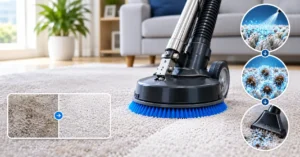
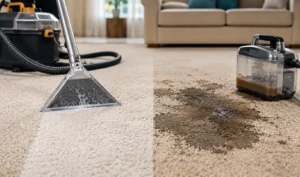
Two quotes for the same carpet, wildly different prices — and one of them warns you’ll be off the floor for half the day. What’s going on? Nine times out of ten, it comes down to the method. The real story behind bonnet cleaning vs hot water extraction is that these aren’t one job with two labels. They clean to different depths, they dry on completely different schedules, and each one suits a particular kind of carpet. Let’s clear it up — and work out which one actually makes sense for your home in Ealing, Acton, Chiswick, Hammersmith or Fulham.
The short answer: Bonnet cleaning is a quick, surface-level tidy-up that’s dry again in about an hour — perfect for a fast refresh or a busy office that can’t shut down. Hot water extraction goes right into the pile and pulls out the embedded grime, dust and allergens, but you’ll wait a few hours for it to dry. For most West London homes that want a proper, hygienic clean, extraction wins. Bonnet cleaning still earns its keep as a light top-up in between.

What is bonnet carpet cleaning?
Bonnet carpet cleaning is a low-moisture method, and it only really touches the top of the carpet. Here’s how it works: a rotary machine spins an absorbent pad — the “bonnet” — that’s been dampened with a cleaning solution. As that pad turns, it scrubs the surface and soaks up the loosened dirt sitting on top of the pile. When the pad gets grubby, you swap it for a clean one and carry on.
The reason people love it is simple — speed. Barely any water goes in, so the floor’s usable again almost straight away. That’s exactly why hotels, corridors and other spaces that can’t be roped off for long lean on it. Really, it’s a clever way of buffing the surface bright rather than washing the carpet through.
Where bonnet cleaning shines
- Speed: the room’s back in use within the hour.
- Instant looks: surface marks and that greying in the walking lanes lift fast, so it looks fresher on the spot.
- Upkeep: it’s a smart in-between clean for busy areas that see a lot of feet.
Where it lets you down
- It reaches maybe the top few millimetres — the soil buried deep in the pile and backing just stays put.
- Lay on too much solution and you get a tacky film that pulls dirt back in faster than before.
- Heavy-handed pad work on the wrong carpet can flatten or fuzz the pile over time.
What is hot water extraction?
Hot water extraction carpet cleaning — most people call it steam carpet cleaning — is the deep clean the carpet makers themselves usually recommend. Hot water and a cleaning agent are pushed into the carpet under pressure, driving the solution down into the fibres. Then, in the very same pass, a strong vacuum yanks it all back out, carrying the dissolved dirt, dust and leftover product with it.
Picture it as genuinely washing and rinsing the carpet instead of wiping its face. Because it flushes the pile top to bottom, it clears out the gritty, allergen-heavy stuff a surface clean never gets near. The catch? Moisture. The carpet stays damp for a bit and wants decent airflow to dry off.
Where hot water extraction shines
Depth: it gets to the base of the pile and lifts the ground-in soil, not just the marks you can see.
Hygiene: that hot rinse and hard extraction help clear dust, dander and the debris dust mites feed on.
Cleaner finish: since the solution is rinsed and sucked back out, far less product is left sitting in the carpet.
Where it lets you down
- Carpet drying time: reckon on a few hours, and longer if the room’s cold or stuffy.
It’s slower and takes more graft, and that shows up in the price.
Over-wet a carpet and skimp on the extraction, and damp can hang around — which is exactly why the person doing it matters.
Bonnet cleaning vs hot water extraction: the key differences
Line them up side by side and the picture gets a lot clearer. Here’s how the two stack up on the things West London customers actually ring us about.
| Factor | Bonnet cleaning | Hot water extraction |
|---|---|---|
| Depth of clean | Surface / top of pile | Full pile, down to the backing |
| Drying time | ~30–60 minutes | ~2–6 hours (depends on airflow) |
| Best for | Quick refresh, busy commercial floors | Deep clean, allergens, heavily soiled carpet |
| Moisture used | Low | Higher (rinsed and extracted) |
| Residue risk | Higher if over-applied | Lower — solution is rinsed out |
| How often | Interim maintenance | Periodic deep clean |
General comparison for typical home carpets. Real results shift with carpet type, how dirty it is, and the kit being used
Depth of clean: quick refresh vs deep carpet cleaning
This is the big one. A carpet hides far more than you’d think — grit, skin cells, pet hair, fine dust, all of it working its way down and settling near the backing. Clean only the surface and yes, the room feels fresher, but that hidden load hasn’t gone anywhere. Proper deep carpet cleaning is different: it agitates and flushes that muck out of the pile for good.
If you’ve got little ones crawling about, a pet, or anyone in the house with allergies, that depth genuinely counts. It’s the gap between a carpet that looks clean and one that actually is.
Chemical residue and carpet fibre health
Every method leaves something behind if it’s rushed. With low-moisture pads, the usual offender is chemical residue — leftover solution that dries into a faintly sticky film and then grabs dirt off shoes and paws, so the carpet re-soils quicker than it did before. A properly done extraction clean rinses most of that product straight back out, and that’s one of its quieter wins.
Carpet fibre matters too. Grind away with a rotary pad over enough cleans and you can distort or fuzz a delicate pile, whereas a gentle, well-judged extraction pass treats most modern carpets kindly. Getting the method — and the settings — to match the carpet is exactly where a technician who knows their stuff pays for themselves.
Cost comparison
Bonnet cleaning is quicker and runs on simpler kit, so per visit it’s normally the cheaper of the two. Extraction eats more time, water, power and skill, so the carpet cleaning cost tends to be higher — but you’re buying a deeper result that stretches further between cleans. We don’t slap fixed prices on the page, because an honest quote depends on how many rooms, what the carpet’s made of, and how grubby it’s got. A quick look, or even a couple of photos, gives you a far fairer number than any one-size figure ever could.
Rule of thumb: weigh it up by cost per result, not cost per visit. A cheap surface clean you’re redoing every few weeks can quietly cost you more than a proper deep clean twice a year.
Getting the best result, whatever you choose
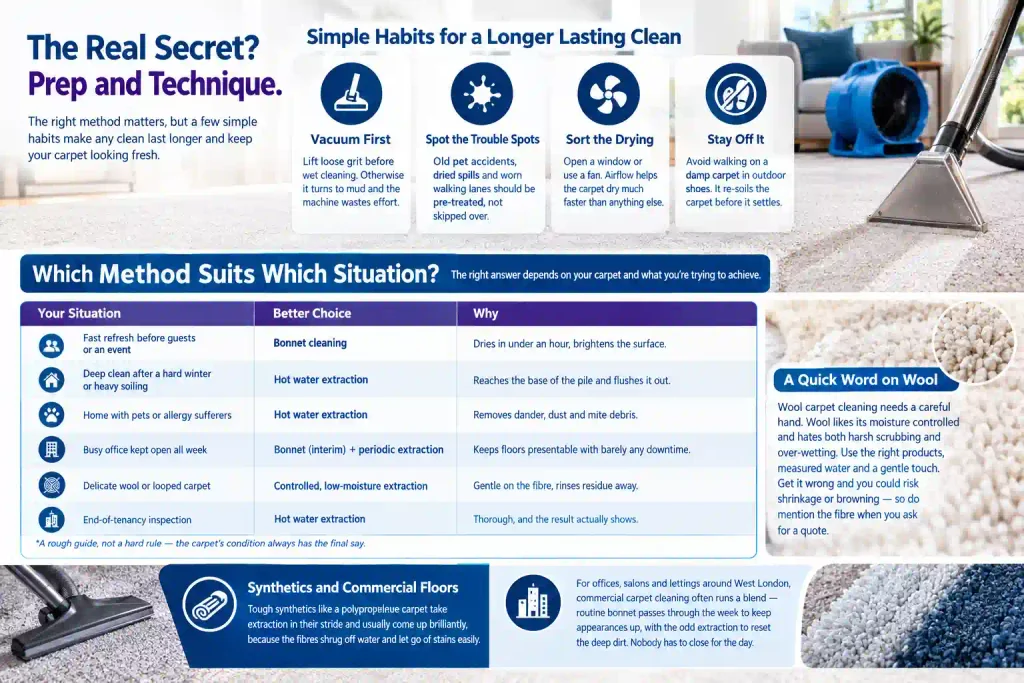
Honestly, the whole bonnet cleaning vs hot water extraction question tends to hog the spotlight when a simpler thing decides the outcome: prep and technique. A few small habits stretch any clean further and keep the carpet looking good for longer.
- Vacuum first. Lift the loose grit before anything wet goes down — otherwise it just turns to mud in the pile, and the machine wastes effort on it.
- Point out the trouble spots. Old pet accidents, dried spills, the worn walking lanes — flag them so they get pre-treated instead of skimmed over.
- Sort the drying. After a deep clean, crack a window or set a fan going. Airflow does more for drying speed than anything else.
- Stay off it till it’s dry. Tramping over a damp carpet in outdoor shoes re-soils it before it’s even had a chance to settle.
None of it is rocket science, but it’s the difference between a clean that fades in a fortnight and one that holds up for months.
Which method suits which situation?
The “right” answer really hangs on the carpet under your feet and what you’re trying to achieve. This quick lookup covers the situations we get asked about most.
| Your situation | Better choice | Why |
|---|---|---|
| Fast refresh before guests or an event | Bonnet cleaning | Dries in under an hour, brightens the surface |
| Deep clean after a hard winter or heavy soiling | Hot water extraction | Reaches the base of the pile and flushes it out |
| Home with pets or allergy sufferers | Hot water extraction | Removes dander, dust and mite debris |
| Busy office kept open all week | Bonnet (interim) + periodic extraction | Keeps floors presentable with barely any downtime |
| Delicate wool or looped carpet | Controlled, low-moisture extraction | Gentle on the fibre, rinses residue away |
| End-of-tenancy inspection | Hot water extraction | Thorough, and the result actually shows |
A rough guide, not a hard rule — the carpet’s condition always has the final say.
A quick word on wool
Wool carpet cleaning needs a careful hand. Wool likes its moisture controlled and hates both harsh scrubbing and over-wetting, so whatever method you use, it wants the right products, measured water and a gentle touch. Get it wrong and you’re risking shrinkage or browning — so do mention the fibre when you ask for a quote.
Synthetics and commercial floors
Tough synthetics like a polypropylene carpet take extraction in their stride and usually come up brilliantly, because the fibres shrug off water and let go of stains easily. For offices, salons and lettings around West London, commercial carpet cleaning often runs a blend — routine bonnet passes through the week to keep appearances up, with the odd extraction to reset the deep dirt. Nobody has to close for the day
So — which is best for West London homes?
For most people the verdict on bonnet cleaning vs hot water extraction is refreshingly simple. Want a genuine, hygienic deep clean? Go with extraction. Just need a quick tidy-up between the big cleans? Bonnet does the job. A period place in Chiswick with wool carpets, a hectic family home in Ealing on synthetic pile, a rented flat in Hammersmith staring down an end-of-tenancy check — all different, all landing on the same principle. Match the method to the carpet, the mess and the deadline, and you’ll get a finish that looks good and genuinely lasts.
Still on the fence about bonnet cleaning vs hot water extraction? Easiest thing to do is tell us about the carpet and what you’re after — a light freshen-up before visitors, or a full reset after a rough few months — and let the method fall out of that, rather than picking the method first and hoping
Not sure which clean your carpet needs? Tell us your rooms, carpet type and postcode across West London and we’ll point you to the right method — no pressure, no hard sell. → Get in touch
Related reading: carpet cleaning, upholstery cleaning, rug cleaning and pet stain & odour removal across West London.
Frequently asked questions
Is bonnet cleaning or steam cleaning better for home carpets?
For a proper home clean, hot water extraction (steam) usually comes out on top — it gets deep into the pile and clears the embedded dirt and allergens. Bonnet cleaning is the one to reach for when you just want a fast surface refresh or a bit of upkeep between the deeper cleans.
Does bonnet cleaning leave residue in the carpet?
It can, if too much solution goes down or the pads aren’t swapped often enough. That leftover product dries into a film that attracts dirt, so the carpet grubs up again faster. Careful, measured application keeps it in check.
Can carpet cleaning damage my carpet?
Done properly, no. The damage you hear about tends to come from over-wetting, harsh chemicals, or aggressive scrubbing on delicate fibres like wool. Matching the method and the settings to the carpet type heads all of that off.
How long does a carpet take to dry after cleaning?
After bonnet cleaning, roughly 30–60 minutes. After hot water extraction, usually 2–6 hours, depending on airflow, temperature and how thick the carpet is. Good ventilation speeds things up a lot.
How often should carpets be professionally cleaned?
As a rough guide, every 12–18 months for the average home — sooner if you’ve got pets, kids or a lot of foot traffic. High-use commercial floors often want interim cleans in between.
Is bonnet cleaning suitable for all carpet types?
No. It’s fine on plenty of hard-wearing synthetics, but it can distort or fuzz delicate and looped pile over time. Not sure what your carpet is? Ask before you book so the right method gets used.